What Is Custom Knife Grinding?
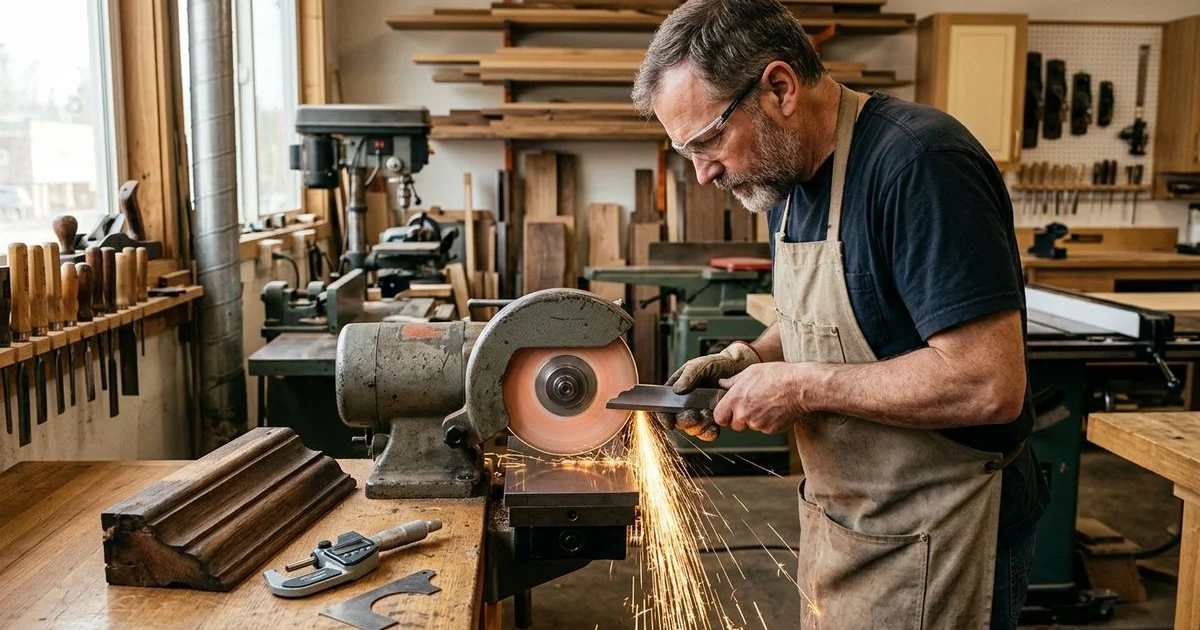
A moulder cuts a profile into a length of timber by spinning a set of shaped knives against it. The shape of the knife determines the shape of the moulding. To produce a profile that no supplier stocks, you grind a knife to the inverse of the section you want.
That is the entire principle, and it is the reason we can reproduce trim from a 1912 Portland Foursquare that has not been manufactured since before the war. It is a defining capability of our Custom Millwork service.
How the Process Runs
1. Obtain a sample. A short offcut of the original is ideal. Failing that, we take a physical template from a clean section, often inside a closet or behind a radiator where paint build-up has not obscured the detail.
2. Draw the section. The sample becomes a precise scaled drawing. Small details carry the character: the depth of a cove, the shoulder of a fillet, the exact radius of a bead. Getting these approximately right is what makes an approximate match.
3. Grind the knife. Steel is ground to the inverse of the drawn section. Symmetry, depth, and edge geometry all have to be correct, because any error will repeat down every foot of moulding produced.
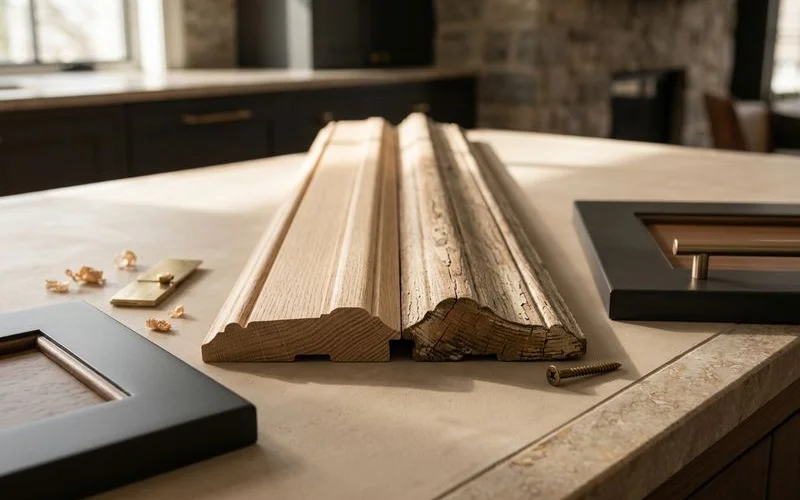
4. Test run. We mill a short sample and check it against the original in hand, then adjust the grind if anything reads slightly off.
5. Mill the run. Once approved, we mill the full quantity in the matched species, plus extra for future repairs.
Why a test run matters
Paint build-up on a century-old sample can hide or soften details. A test piece milled in bare timber shows the true profile, which is where a small correction can still be made cheaply.
Matching the Species Too
Profile is half the match; species is the other half. Much of Portland’s older trim is Douglas fir, often old-growth stock with tight, close grain that modern fir does not naturally match. Some houses used cedar, hemlock, or oak in specific applications.
We select stock to match grain character as well as species, because a correct profile in visibly wrong timber still reads as new work, particularly under a clear or lightly tinted finish.
When It Is Worth Doing
- Extending an existing run of original trim
- Replacing damaged sections within otherwise intact millwork
- Historic-district projects that require demonstrable matching
- Houses with unusual local profiles, which Portland has many of
- Whole-house programmes where consistency across rooms matters
The knife is a one-time setup cost, and it keeps paying. Once ground, we can mill from it again years later when a subsequent phase of the house needs the same profile. Knife grinding is one route among several, and our guide to matching historic millwork and moulding profiles sets out when a stock profile will do instead.
The Documentation Side
For preservation review, we record the original profile, the drawn section, the species specification, and photographs of the test piece alongside the original. That package is what turns “we matched it carefully” into something a reviewer can actually assess, and it is one of the reasons heritage projects in Irvington and Laurelhurst tend to move faster when the millwork evidence is prepared early.