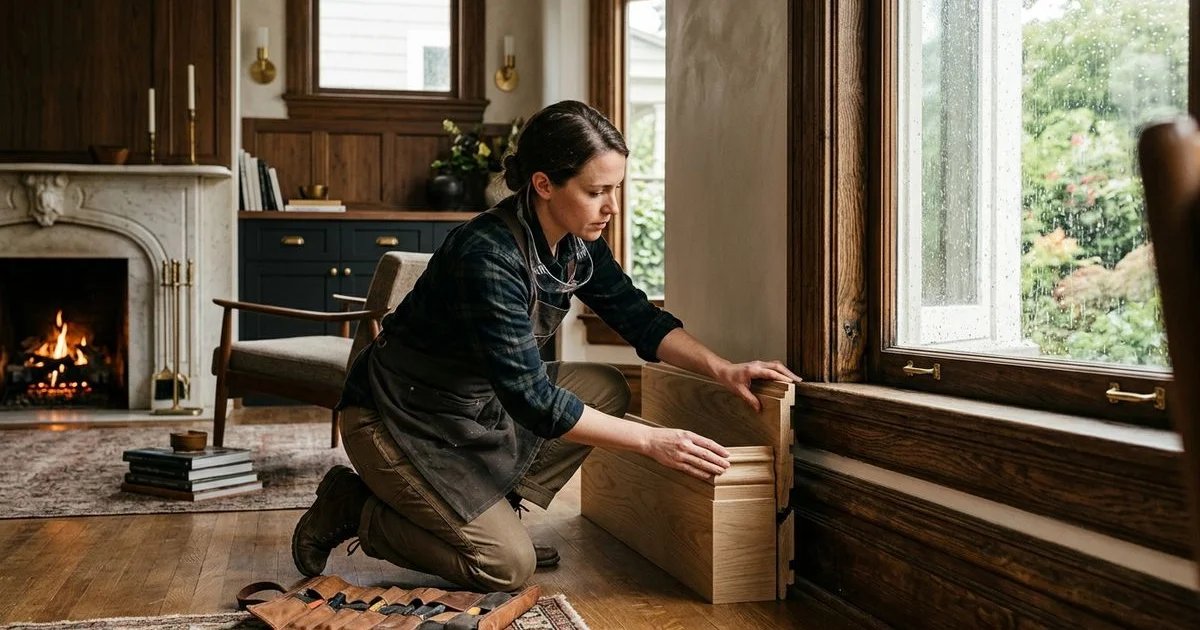
Why Is Matching Historic Millwork So Difficult?
Because the profiles no longer exist. Early-century Portland homes were trimmed with mouldings milled locally to patterns that went out of production decades ago. Walk into any lumberyard today and the closest available profile will be near enough to look wrong: a slightly different fillet, a shallower cove, a bead in the wrong place.
The eye is remarkably good at catching this, even in people who could not name what is bothering them. A run of new casing beside original casing reads as a mismatch immediately, and it undermines an otherwise careful renovation.
Getting it right is a milling problem, and it is a core part of our Custom Millwork service.
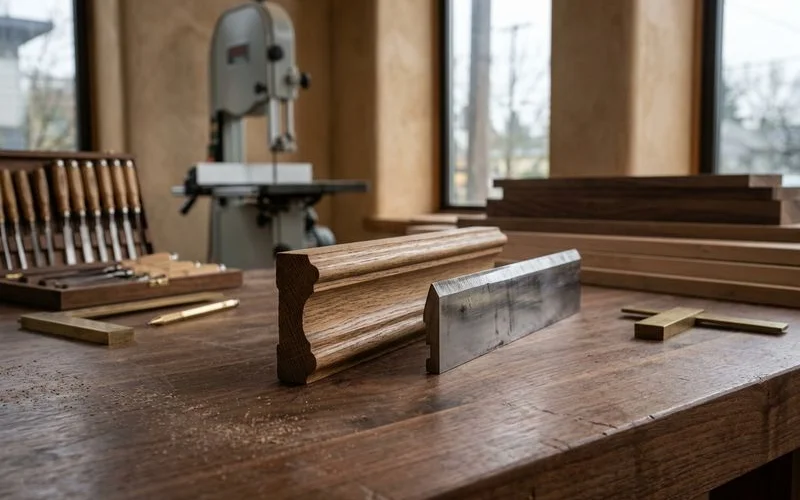
How Profile Matching Works
Take a sample. Ideally a short offcut of the original. Failing that, we take a physical template from an unpainted section, often from inside a closet or behind a radiator where the profile survives without a century of paint build-up.
Draw the section. The template becomes a scaled drawing of the exact profile, including the small details that carry most of the character: the depth of a cove, the shoulder of a fillet, the reveal at a backband.
Grind the knife. A moulder knife is ground to the inverse of that section. This is the step that makes an exact match possible, and it is why shops without this capability can only offer approximations.
Match the species. Portland’s older homes are frequently trimmed in Douglas fir, sometimes in old-growth stock with tight, close grain that modern fir does not match easily. Species selection matters as much as profile.
Match the finish. Old finishes have shifted colour over decades. We prepare test panels and check them against the original in your own daylight, not under shop lighting.
What a bad match looks like
Correct overall size, wrong internal details. The run reads as trim rather than as part of the house. Once you have seen a genuine match beside an approximate one, the difference is impossible to unsee.
When You Need a Custom Knife
- The original moulding is discontinued and no stock profile is close
- You are extending an existing run rather than replacing a whole room
- A historic-district review requires demonstrable matching
- The house has an unusual local profile, which is common in Portland
- You are replacing damaged sections within otherwise intact original trim
For a whole-room replacement where nothing original survives, a well-chosen stock profile can be an honest choice. For anything that meets original work, the knife is worth it, and our guide to custom knife grinding for historic profile replication walks through how that setup actually happens.
Documentation for Preservation Review
Where a review applies, evidence matters as much as craft. We prepare profile drawings, species and finish specifications, and photographic records of the original alongside the proposed work.
Requirements differ by district and by scope, so ask early. Approvals take the time they take, and the projects that run smoothly are the ones that started the conversation before fabrication was scheduled.
The Installation Detail
Matching the profile is half the job. The other half is the install: coped inside corners rather than mitred, mitred returns at exposed ends, and everything scribed to walls that have moved over a century.
Get both halves right and the join between original and new becomes genuinely difficult to find. That is the standard the work should be held to, and it is the one our clients in Irvington and Laurelhurst hold us to.