What Is the Real Difference?
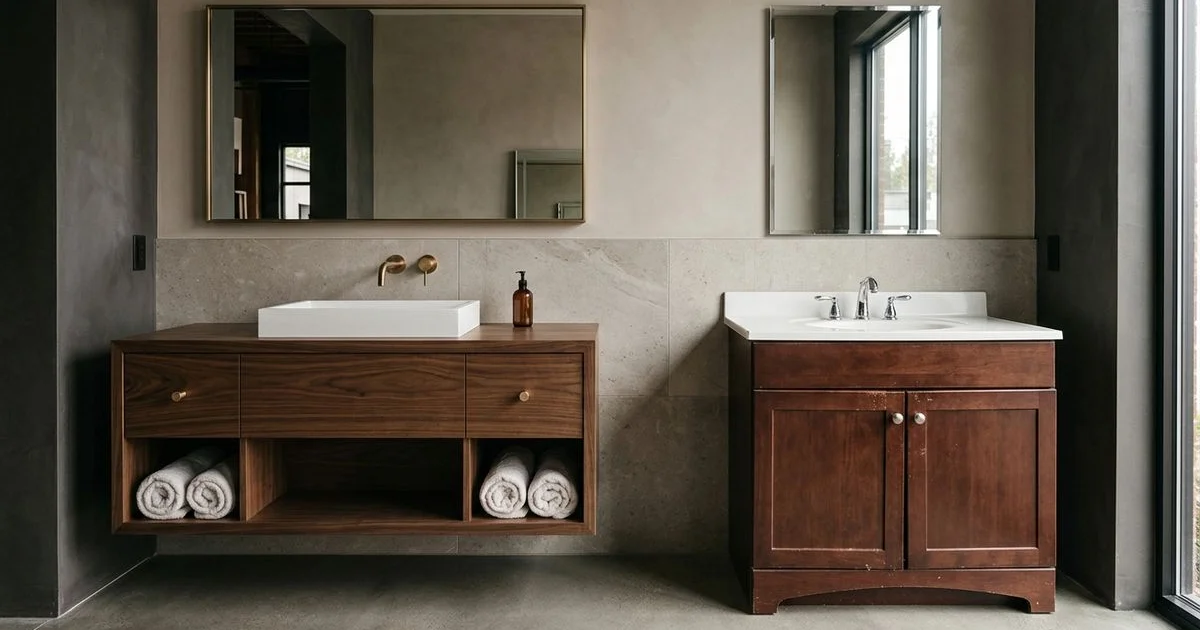
A stock vanity is a finished unit built to a nominal width. You choose the closest size, install it, and close the leftover gap with a filler or a scribe strip. A custom vanity is built for the opening you actually have, in the materials you choose, with the storage layout you need.
In a square, standard-sized bathroom, the gap between those two is smaller than people assume. In the bathrooms most Portland homes actually have, the gap is large. That is the honest framing behind everything we build in our Bathroom Vanities service.
Where Custom Wins
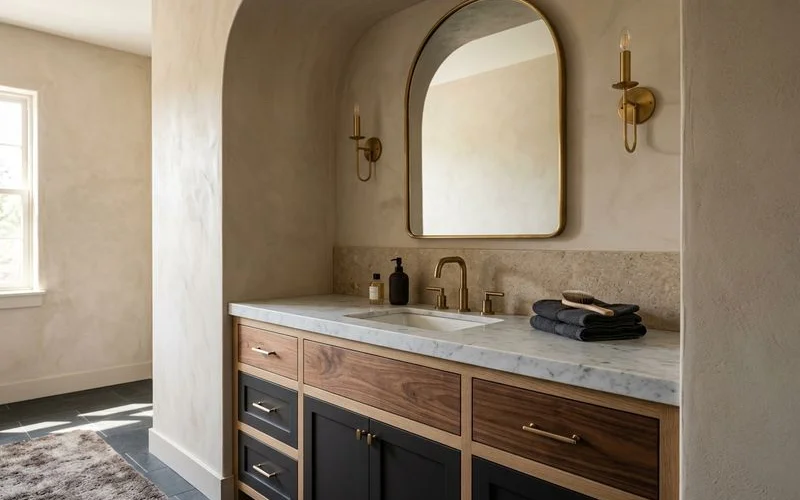
Odd openings. Older bathrooms rarely present a clean 36 or 48 inch space. A vanity built to the actual alcove uses every inch and needs no fillers, which is immediately visible in a small room.
Material quality. Bathrooms are the harshest environment in the house for cabinetry. We build with moisture-resistant MR-MDF or marine-grade plywood cores, seal every face including the underside, and finish with conversion varnish. Many stock vanities use standard particleboard with only the visible faces sealed, which is why they swell at the base first.
Storage that works around plumbing. Solid-wood dovetailed drawers with U-shaped cutouts pass around the trap, recovering most of the volume a standard sink base gives away to a fixed shelf and a void.
Matching the house. Species, stain, door style, and hardware matched to your kitchen or existing trim. In a period home, a floor-mounted vanity with beaded inset doors and unlacquered brass belongs; a retail unit almost never does.
The test that decides it
Measure your opening. If a standard width lands within an inch or two and the room is square, stock is a defensible choice. If you would need more than a token filler, or the wall is out of plumb, custom is the only route to a clean result.
Where Stock Makes Sense
Secondary bathrooms, rentals, powder rooms in newer homes with square openings, and projects where budget governs the whole scope. There is no virtue in over-specifying a guest bathroom that gets used twelve times a year.
Side by Side
| Stock vanity | Custom vanity | |
|---|---|---|
| Sizing | Fixed widths plus fillers | Built to the actual opening |
| Core material | Often standard particleboard | MR-MDF or marine-grade plywood |
| Sealing | Visible faces | All faces, including undersides |
| Drawers | Fixed shelf or basic box | Dovetailed, U-cut around the trap |
| Finish matching | From a set range | Matched to your existing joinery |
| Lead time | Immediate to weeks | Several weeks |
| Cost | Lower | Higher, quoted per project |
What We Would Suggest
Bring us the measurements and a photo of the room. If your opening is standard, the walls are true, and the budget is tight, we will tell you that a good retail vanity is a reasonable call.
If your bathroom is an awkward shape, if it sits in a period home, or if the rest of the house is finished to a high standard, custom is where the money does visible work. It is also the only route to a floating vanity properly blocked into the wall, which is the detail that makes a small bathroom feel considerably larger. Our comparison of floating and floor-mounted vanity designs covers what that choice involves.