Why Do Bathroom Cabinets Fail?
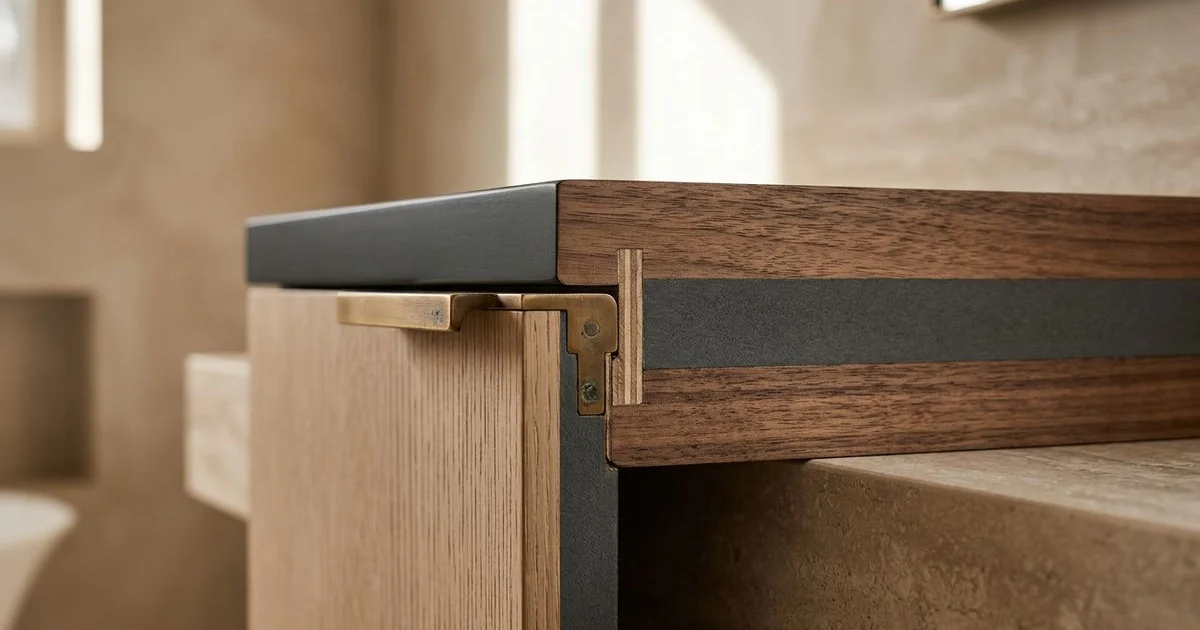
Almost always the same way, and almost never where people expect. The door front is fine. The failure is at the base of the sink cabinet, at the back edge against the wall, or on the underside of a panel nobody has looked at since installation.
Water reaches an unsealed edge, the substrate absorbs it, the panel swells, and the swelling breaks the finish, which lets more water in. In a Pacific Northwest bathroom, where indoor humidity stays high through a long wet winter, that cycle runs faster than it does elsewhere.
Every vanity we build through our Bathroom Vanities service is specified around that failure mode.
The Materials That Work
MR-MDF (moisture-resistant MDF). Denser than standard MDF with a resin system formulated to resist water uptake. It machines beautifully, which makes it excellent for painted doors and panels where a perfectly smooth surface matters. It is not waterproof, and it must be sealed.
Marine-grade plywood. Void-free plies bonded with a water-resistant adhesive. It is the strongest and most stable option for cabinet boxes in a wet room, holds fixings well, and tolerates the occasional plumbing incident far better than any MDF product.
Solid hardwood. Correct for doors, face frames, and drawer sides. A framed door lets its panel float, so seasonal movement does not split it. Solid wood is not the right choice for wide box panels, because unrestrained width movement is exactly what you are trying to avoid.
What we avoid. Standard particleboard, and any thin veneered board with an exposed raw edge. Both fail predictably once moisture arrives.
The rule that actually matters
Seal every face. Tops, bottoms, backs, undersides, cutout edges around plumbing, and the inside of the sink base. Sealing only what shows is the most common shortcut in vanity construction and the direct cause of most failures.
The Finish
We use the same catalysed conversion-varnish system on vanities as on kitchens. It cures to a hard, dense, chemically resistant film that stands up to standing humidity, cleaning products, and daily splash far better than lacquer or a site-applied paint.
Site-applied finishes are the weak link in most bathroom cabinetry. They cannot be cured under controlled conditions, and they rarely reach the hidden faces where protection matters most.
| Component | Our specification | Why |
|---|---|---|
| Box | Marine-grade plywood or MR-MDF | Stability and water resistance |
| Doors | Solid hardwood or MR-MDF | Smooth painted finish, framed movement |
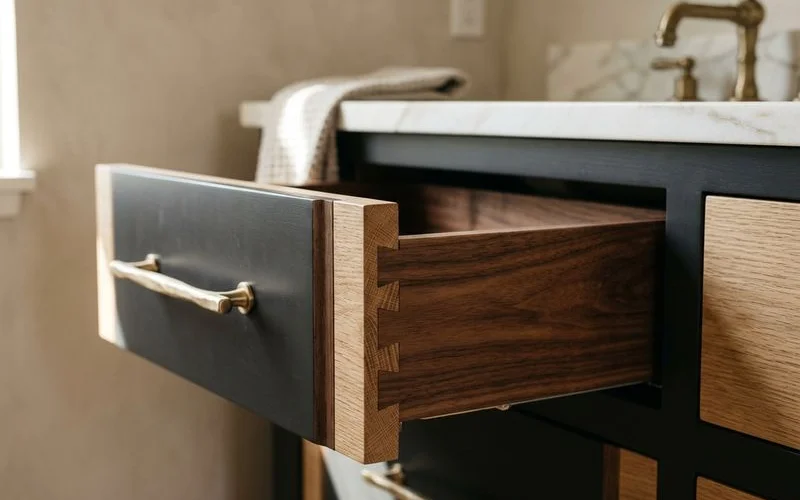
| Drawers | Solid wood, dovetailed | Handles humidity and heavy use |
| Glides | Blum undermount soft-close | Concealed, full extension, durable |
| Finish | Conversion varnish, all faces | Hard, moisture and chemical resistant |
Detailing Around the Plumbing
The cutout at the back of a sink base is the most common water entry point, and it is usually left raw. We seal every cutout edge, and we build drawers with U-shaped profiles that pass around the trap, so the space is usable and the panel edges are still protected.
For floating vanities, we also plan the wall blocking during design. A wall-hung unit carries its entire load through those fixings, and discovering there is nothing solid behind the tile is not a problem you want on installation day. If you have not settled that question yet, we compare floating and floor-mounted vanity designs in detail.
Looking After It
Wipe standing water rather than letting it sit, particularly along the base and around the tap. Run the extractor during and after showers. Use a soft damp cloth for cleaning, and skip abrasive pads and ammonia-based products.
Do that and a properly built vanity will look right for decades, even in a Portland bathroom that sees daily use through a long wet winter.