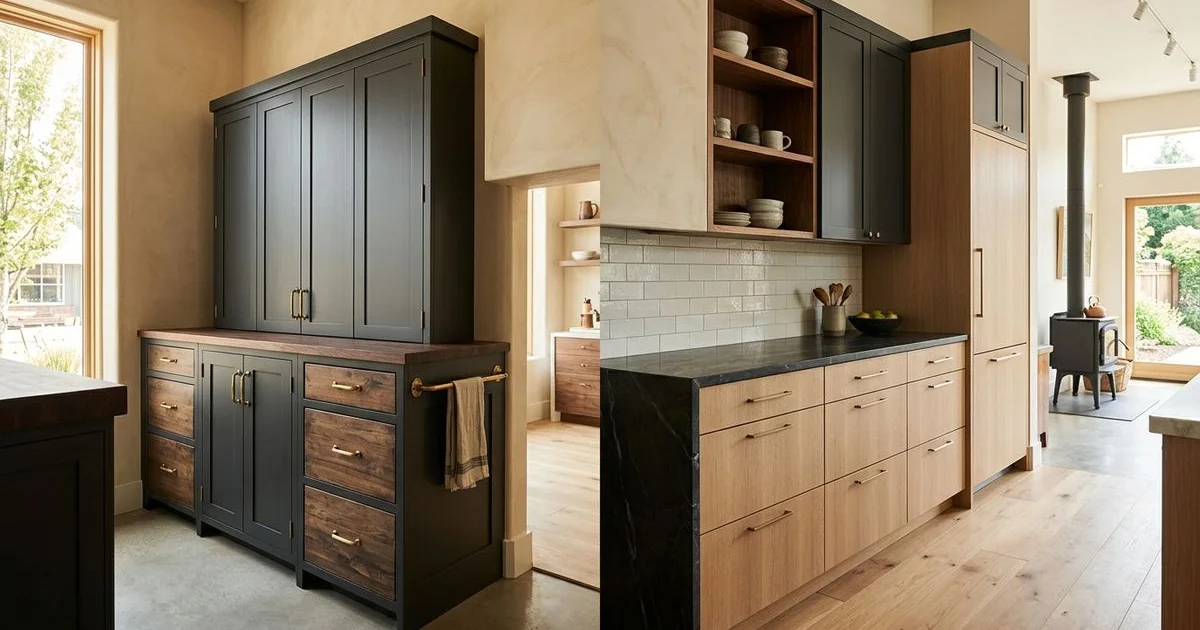
Should You Restore or Replace Your Cabinets?
You likely already know that cabinets dictate the entire feel of a luxury kitchen.
A 2026 National Kitchen and Bath Association report shows that minor cosmetic updates deliver a 113% national return on investment, while major gut renovations often return less than 47%. That massive gap makes the cabinet refinishing vs replacement decision incredibly important.
We build new layouts daily through our Custom Kitchen Cabinets division, so our financial interest leans toward replacement. That obvious bias aside, pushing money into a surface restoration first tends to result in money spent twice if the underlying bones are weak.
A kitchen that never actually needed a full teardown simply makes for a bad portfolio reference.
Our team prefers to look at the hard data, examine structural integrity, and outline a practical test to help you make the right call. The decision comes down to two straightforward questions: are the boxes sound, and does the current layout still work?
When Refinishing Makes Sense
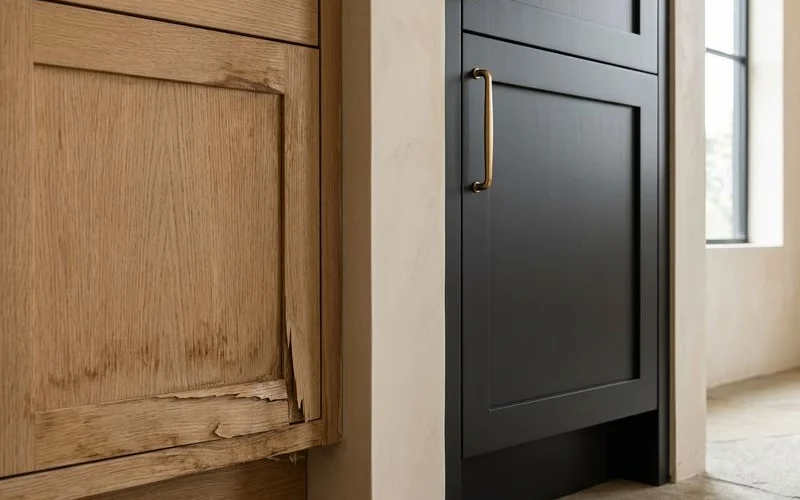
Our team usually suggests refinishing when the underlying wood remains structurally perfect. Stripping or sanding the existing doors and applying a commercial-grade conversion varnish provides a factory-quality surface that lasts 10 to 15 years.
Refacing takes this a step further by installing new doors and drawer fronts over the existing boxes. We find that both methods offer excellent value under the right conditions. A professional cabinet refacing project occupies the middle ground, while a spray refinish typically costs between $1,500 and $3,500 for a standard kitchen, keeping your budget intact for other property upgrades.
These approaches work best when:
- The boxes are solid plywood and remain completely square and dry.
- Hinges and glides function perfectly or can accept easy upgrades.
- The existing layout perfectly matches how you cook and entertain.
- The doors feature solid wood construction rather than peeling thermofoil.
- The timeline requires completion in 3 to 5 days rather than weeks.
We frequently see this exact scenario in Portland’s historic luxury properties. Preserving the original beaded inset doors in a pre-war mudroom honors the architecture.
Stripping decades of thickened paint and applying a modern finish produces a result that new construction rarely matches.
When Replacement Is the Better Investment
We point clients toward full replacement when structural failures compromise the base cabinets. The National Kitchen and Bath Association confirms that new cabinetry consumes roughly 29% to 35% of a complete remodel budget, making it the largest single investment. Spending that kind of money requires a layout that genuinely solves your daily frustrations.
Our experience shows that replacement becomes the only logical path when:
- Particleboard boxes have swollen, sagged, or delaminated from humidity.
- Severe rot exists on water damaged cabinets below a sink or dishwasher.
- Blind corners and wasted soffits make the kitchen frustrating to use.
- The renovation requires moving plumbing lines, gas pipes, or load-bearing walls.
- You demand inset doors but currently have frameless carcases.
That final point about door styles catches many property managers off guard. Door configurations rely entirely on the underlying box construction.
We want to be clear that changing a frameless carcase to accept true inset doors requires rebuilding the entire front edge of every box. By the time that labor finishes, the project cost nearly equals a brand new installation.
The layout test
If your complaint is “it looks tired”, refinishing solves it. If your complaint is “I can never reach anything in that corner”, refinishing does not solve it, and no amount of new paint will.
How the Options Compare
Our clients often ask for a clear, side-by-side comparison before making a final choice. The table below breaks down exactly what each method addresses. Industry averages from 2026 highlight the stark differences in typical timelines and financial impacts.
| Feature | Refinishing | Refacing | Replacement |
|---|---|---|---|
| Addresses appearance | Yes | Yes | Yes |
| Addresses layout | No | No | Yes |
| Fixes damaged boxes | No | No | Yes |
| Door style change | Limited | Yes, within box type | Fully unlimited |
| Typical 2026 Cost | $1,500 to $3,500 | $4,500 to $10,500 | $25,000 to $75,000+ |
| Project Timeline | 3 to 5 days | 3 to 5 days | 6 to 12 weeks |
| Service life gained | 10 to 15 years | 15 to 20 years | Multiple decades |
Cost, Honestly
We track local pricing closely to ensure accurate recommendations. Refinishing sits at the lowest end of the pricing spectrum by a wide margin. A professional refacing update occupies the middle tier.
- Refinishing: Typically $1,500 to $3,500.
- Refacing: Averages around $6,750 nationally.
- Replacement: Often exceeds $25,000 for standard custom layouts.
Our data shows that this major investment remains the only solution that resolves poor traffic flow and structural rot. The biggest trap is the middle path taken for the wrong reason. Avoid spending substantial capital on half-measures.
We see property owners spend eight thousand dollars to reface a kitchen with a terrible layout, which guarantees frustration every time they cook. That misallocated budget usually leads to a full replacement just three or four years later.
If the floor plan causes daily headaches, spend the money once on a proper remodel. Our breakdown of how much custom cabinets cost in Oregon sets out the bands a full replacement realistically falls into.
What We Would Do at Your House
We follow a strict, four-point inspection process before recommending any specific service. The evaluation starts with the structural boxes, moves to the internal hardware, assesses the physical room layout, and finally examines the cosmetic door condition. This systematic approach removes guesswork from the equation.
Our team will explain the precise physical evidence driving a replacement recommendation if the boxes show signs of failure. The objective is to provide verifiable facts rather than aggressive sales tactics. If a simple spray finish will protect your investment, that is exactly what the proposal will state.
Request a consultation and we will give you that assessment in person, with zero obligation attached to it.