How Do You Choose a Wood Species?
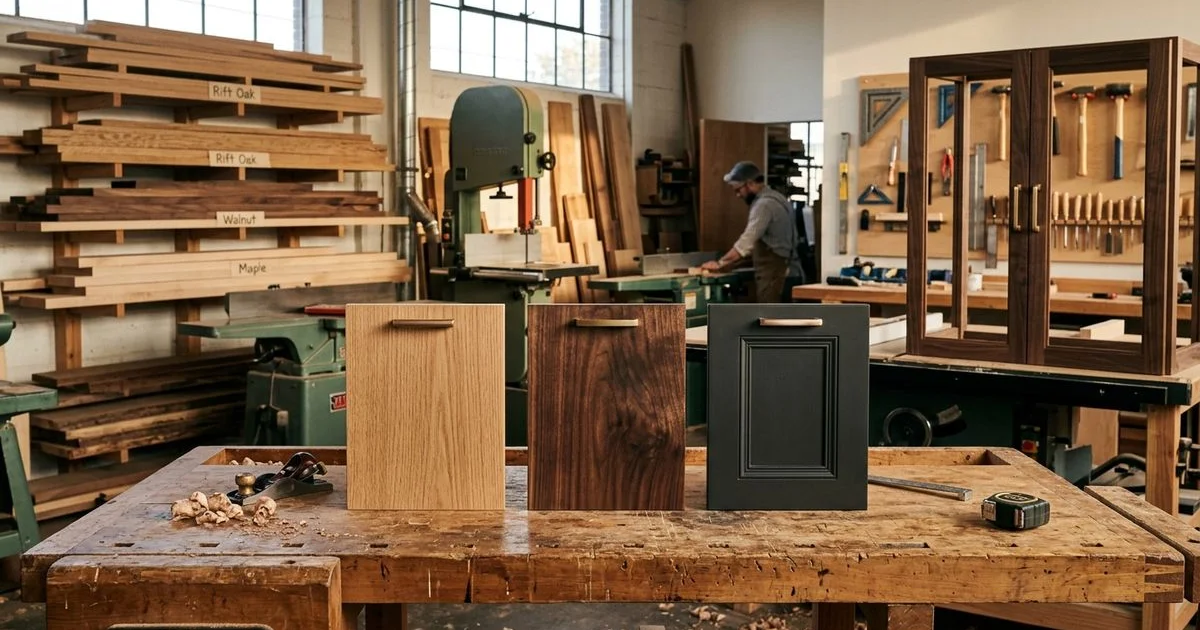
There are three questions worth asking, in this order. What finish do you want, painted or stained? What is the room’s architecture asking for? And how hard will the surface be worked?
Answer those and the species usually chooses itself. Almost every kitchen we build through our Custom Kitchen Cabinets service uses one of three: solid maple, rift-cut white oak, or black walnut. Each one exists in the palette for a specific reason.
Solid Maple: The Painted Kitchen Default
Maple has a tight, closed grain and very little figure. Under a stain that can read flat and uninteresting, which is why it is rarely our first choice for stained work. Under paint it is close to perfect.
Open-pore species such as oak show their grain through paint as a faint texture. Some people like that; most people choosing a painted kitchen do not, because it undermines the smooth, furniture-like plane they were picturing. Maple gives that plane.
It is also hard. On a working base run with drawers opened several times a day, maple takes the wear better than walnut and roughly as well as oak. For a painted Portland kitchen with beaded inset or Shaker doors, it is the obvious specification.
Rift-Cut White Oak: The Stained Contemporary Choice
White oak is durable, stable, and takes stain evenly. The interesting part is the cut. Plain-sawn oak shows the broad cathedral arches most people picture when they think of oak. Rift-cut oak, sawn at an angle to the growth rings, gives straight, consistent, almost linear grain with none of that arching.
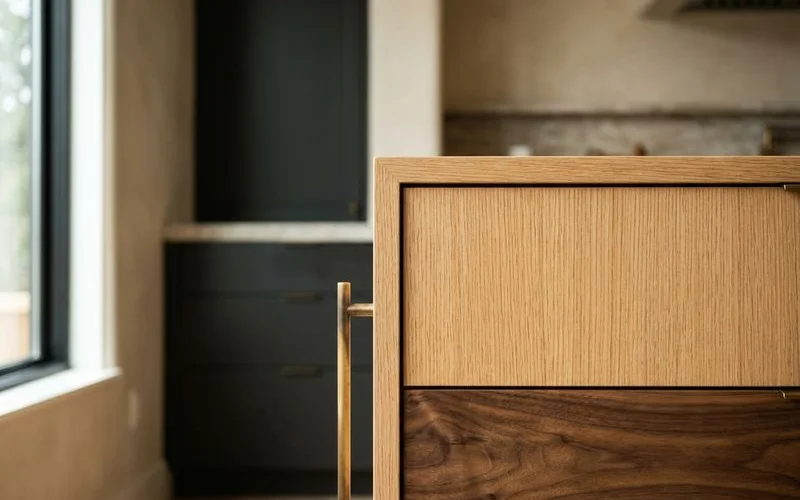
That consistency is what makes rift-cut so useful in contemporary design. It reads calm rather than busy, and because the figure is uniform we can grain-match across a run of drawer fronts so the pattern flows continuously instead of restarting at every gap. On a long island or a full wall of tall cabinetry, that continuity is what separates bespoke work from assembled work.
Rift cutting yields less usable timber per log than plain sawing, so it costs more. It is one of the few upgrades where the visual difference is immediately obvious even to people who cannot say why.
Black Walnut: The Statement Species
Walnut is the warmest of the three, running from chocolate brown to purple-grey with sweeping, complex figure. It needs no stain, and it should not get one; the whole point is the natural colour.
We use it where a single element should carry the room. An island, a run of furniture-style base cabinets, a library wall, a floating vanity. Against honed marble or a pale painted perimeter it does something no other species does at this price point.
Two practical notes. Walnut is softer than maple, so it marks more readily under heavy use, and its colour lightens with UV exposure over years. A UV-resistant topcoat slows that considerably, and in a room with strong south-facing light it is worth specifying.
Which Should You Choose?
| Species | Best for | Finish | Notes |
|---|---|---|---|
| Solid maple | Painted kitchens, hard-working runs | Paint | Tight grain, will not telegraph |
| Rift-cut white oak | Stained contemporary kitchens | Light to medium stain | Grain-matchable, very stable |
| Black walnut | Islands, furniture pieces, vanities | Clear or oil-effect | Rich colour, softer, lightens in UV |
The most common specification we build is a combination: painted maple perimeter, rift-cut white oak tall cabinetry, and a walnut island. It gives the room warmth and hierarchy without becoming a timber showroom. Whatever species you land on, the finish over it does most of the protective work, which we cover in conversion varnish finishes and Pacific Northwest moisture.
Whatever direction appeals, look at real samples in your own light before committing. Stain reads completely differently under a north-facing Portland window than it does under showroom lighting. Request a consultation and we will bring finished samples to the house rather than asking you to imagine them.