
Why Does Finish Matter So Much Here?
Portland puts cabinetry through an unusual annual cycle. Indoor humidity climbs through a long wet winter, drops through a dry summer, and spikes locally every time a dishwasher opens or a shower runs. Wood responds by absorbing and releasing moisture, and the finish is what governs how quickly that exchange happens.
A poor finish is a slow leak. Moisture reaches the substrate through unsealed edges and hidden faces, the panel swells, the joint stresses, and within a few seasons doors catch and reveals drift. It rarely looks like water damage. It looks like the kitchen has simply gone out of alignment, and it is one of the most common complaints we hear about cabinetry built elsewhere.
That is why every kitchen we build in our Custom Kitchen Cabinets service, and every vanity in our Bathroom Vanities service, is finished with a conversion-varnish system and moisture-balancing sealers.
What Is Conversion Varnish?
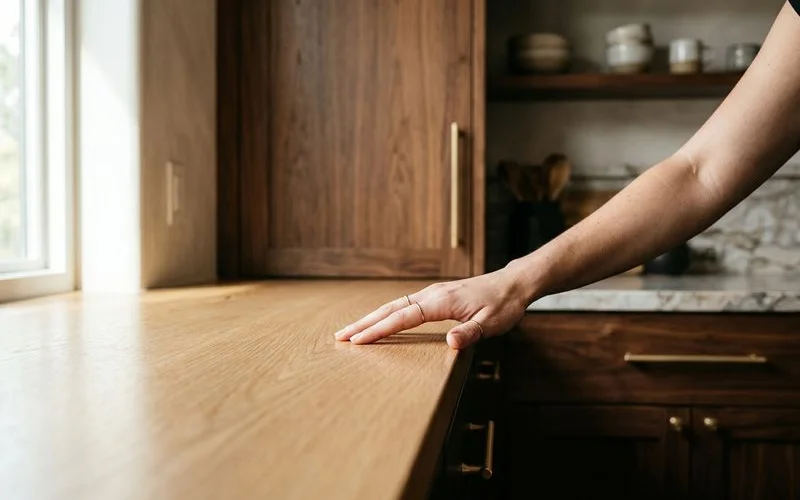
It is a catalysed two-part finish. An acid catalyst is added to the varnish immediately before spraying, and the film cures through a chemical reaction rather than by solvent evaporation alone. The result is a harder, denser, more cross-linked film than standard lacquer or single-component polyurethane.
Practically, that means three things. It resists moisture ingress far better. It resists household chemicals, so cleaning products and the occasional splash of wine or citrus do not dull it. And it holds its sheen and clarity for many years rather than yellowing and softening.
The trade-off is that it must be shop-applied. It needs controlled temperature, humidity, and ventilation, and it needs proper cure time between coats. You cannot brush it on site, which is exactly why cabinetry finished in a controlled finishing room outperforms cabinetry painted after installation.
The part nobody sees
Sealing only the visible faces is the single most common shortcut in cabinet finishing. Moisture does not enter through the door front; it enters through the unsealed underside of a sink base or the raw back edge of a case. We seal all faces, every time.
How Do the Common Finishes Compare?
| Finish | Hardness | Moisture resistance | Where it is applied |
|---|---|---|---|
| Standard lacquer | Moderate | Fair | Shop |
| Single-component polyurethane | Good | Good | Shop or site |
| Conversion varnish | Excellent | Excellent | Shop only, controlled conditions |
| Site-applied paint | Low to moderate | Poor at edges | Site |
For a Portland kitchen or bathroom, the difference between the top and bottom of that table shows up within about three winters.
Looking After the Finish
Conversion varnish is genuinely low maintenance, but a few habits extend its life considerably. Wipe with a soft damp cloth and dry afterwards. Skip abrasive pads and ammonia-based cleaners. Avoid silicone-based polishes, which leave residues that complicate any future refinishing. Wipe standing water around sinks and near the dishwasher promptly, because no finish is designed to sit under a puddle indefinitely.
Do that and the finish should still look right in a decade. If a section ever does need attention, a shop-applied finish can be repaired or refinished cleanly, which is another quiet advantage over site-painted cabinetry — and it is often the deciding factor in cabinet restoration and refinishing versus replacement.