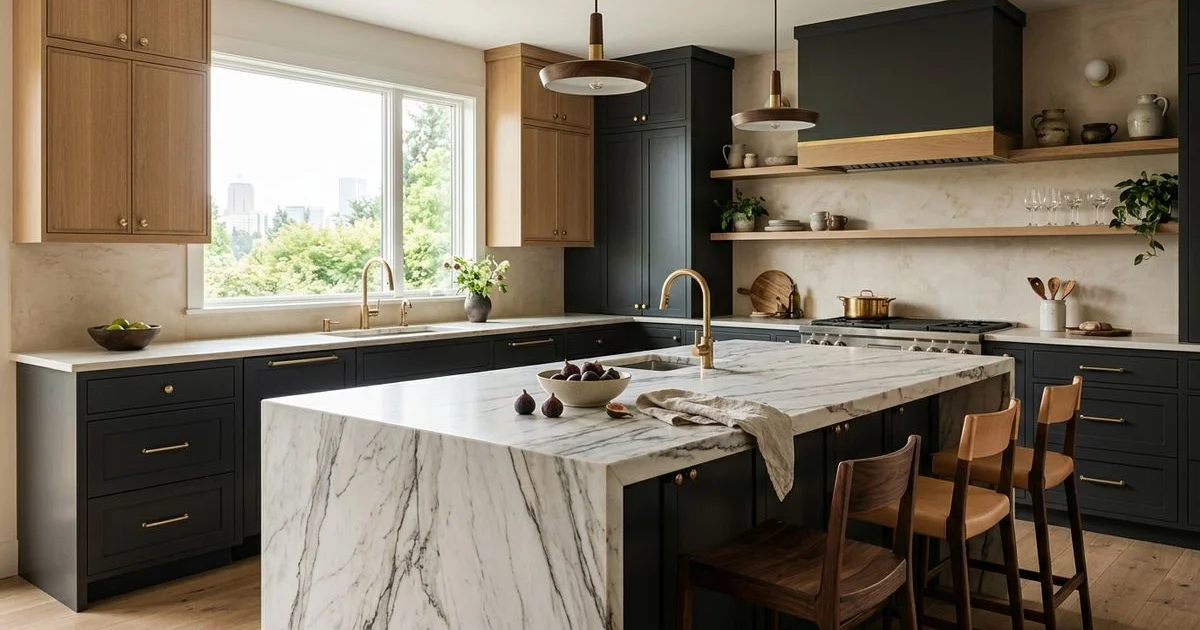
Is Custom Cabinetry Actually Worth It?
Are custom kitchen cabinets worth it? It depends entirely on your house and how long you plan to stay. We hear this question constantly, and the honest truth is that the value comes down to daily function versus upfront expense.
Stock cabinets from big-box stores look like a budget-friendly choice on paper. Our experience shows those savings often vanish when you factor in wasted corner space and shorter structural lifespans.
Let us break down the four concrete things you are actually buying with a custom installation. This roadmap will help you judge whether each factor applies to your specific property.
Everything below reflects how we build through our Custom Kitchen Cabinets service.
1. Fit, Which You Cannot Buy Any Other Way
Fit is the single biggest argument for going custom, especially in older homes with uneven surfaces. We find this carries massive weight in Portland, because century-old walls are rarely square and floors often slope.
Stock cabinets are manufactured in fixed three-inch increments. If your wall length does not divide perfectly by three, installers must use wide filler strips to close the resulting gaps. You are essentially paying for blank wood panels that provide zero storage capacity.
Made-to-measure cabinetry is scribed directly to the actual shape of the wall. Our installation process ensures the woodwork looks like an original part of the building. In an awkward room, this precision is never just cosmetic. It is the exact difference between a kitchen that feels considered and one that looks awkwardly squeezed into a problem space.
Perfect fit also recovers an enormous amount of storage area. We routinely add a full pantry’s worth of usable space just by running cabinets to the ceiling instead of stopping at a soffit. Custom corner units feature articulated pull-out trays that bring items to you, rather than letting deep corners become dark dead zones.
Why Standard Increments Fall Short
- Wasted space: Three-inch gaps add up quickly in small or angled kitchens.
- Lost vertical volume: Stock uppers rarely match ceiling heights perfectly.
- Awkward transitions: Standard boxes struggle to wrap smoothly around chimney chases or structural pipes.
2. Materials and Joinery That Outlast the Trend
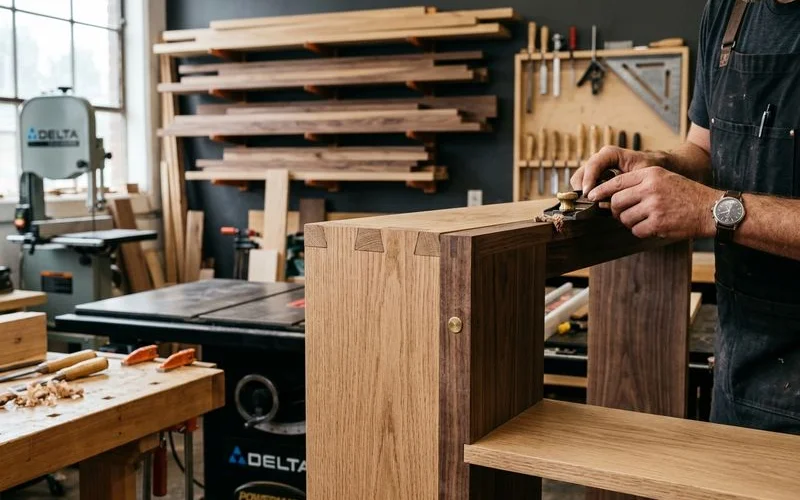
Premium material choices and superior hardware determine if a kitchen will still operate flawlessly in fifteen years. We prioritize quality plywood boxes, solid-wood dovetailed drawers, and catalyzed conversion-varnish finishes. None of these structural elements are visible from the outside, but they form the foundation of a lasting renovation.
Mass-produced stock cabinets frequently rely on thin particle board and hot-melt glue. Our builders know that cheaper construction rarely fails all at once. Instead, it slowly degrades over a few years.
Doors begin to drop, drawer reveals drift out of alignment, and a swollen sink base makes the whole room feel tired. Standard hardware endures hundreds of cycles a month, which wears down basic hinges rapidly.
The Hardware and Lifespan Difference
To prevent this sagging, custom builds use heavy-duty soft-close telescopic slides and premium European hinges. We typically recommend Blum hardware rated for at least 45 kilograms. This load capacity easily handles heavy cast iron skillets and stacked ceramic tableware without stressing the cabinet frame.
That structural degradation is why the replacement cycle for budget tiers usually hits the 10 to 15 year mark. Custom cabinets built from premium wood species like white oak or cherry are engineered to last 25 years or more.
The arithmetic worth doing
A kitchen replaced twice in twenty years costs more than one built once to last thirty, before you count the disruption of doing it twice. If you plan to stay, that comparison is the honest one.
3. Resale, With Appropriate Caution
Kitchens influence potential home buyers more than almost any other room in a house. Our team observes that in luxury and historic real estate markets, buyers absolutely notice inset doors, solid hardwood, and a layout that matches the architecture.
A 2026 real estate market analysis indicates that high-end kitchen upgrades can deliver up to a 75 percent return on investment. You must still be careful with the average return figures published online, as they vary enormously by region and neighborhood norms.
The average cost of a custom cabinet installation across the United States in 2026 is roughly $7,472, though premium projects easily exceed $30,000. Our consultants always remind clients that over-improving a modest home rarely returns its full cost.
How Quality Cabinets Impact a Sale
The most defensible financial claim is narrower but still incredibly valuable. Quality custom cabinetry removes a major objection that buyers would otherwise use to negotiate the price down, which directly protects your cabinet resale value.
- Reduces time on market: Premium finishes help homes sell faster in luxury segments.
- Signals overall quality: High-end woodwork suggests the rest of the home is equally well-maintained.
- Eliminates immediate work: Buyers pay a premium to avoid managing a renovation themselves.
We will always give you a straight answer if your planned project exceeds what your specific property warrants. The reverse also holds true, as under-improving a luxury estate will actively deter discerning buyers.
4. The Daily Experience
The daily functional experience is harder to quantify, but it is consistently what clients mention a year after completion. Our designers focus on eliminating the minor daily frustrations that plague standard kitchens.
You interact with a kitchen several times a day for as long as you live in the house. Small frictions removed permanently are worth more than the same money spent on almost anything else in a renovation.
Upgrades That Change How You Cook
True custom cabinet value lies in the specific, targeted features that make cooking easier. We regularly integrate specialized hardware that transforms how you use the room.
- Heavy-duty drawers: Custom glides open fully while loaded with heavy cast iron pans.
- Personalized pantries: Shelving spaced precisely to hold the specific bulk items you actually buy.
- Appliance garages: Dedicated compartments keep coffee makers and toasters hidden to ensure clear countertops.
- Acoustic control: Soft-close doors shut completely silently at eleven at night.
Investing in these specific, millimeter-perfect details removes the awkward bending, reaching, and adjusting required by standard setups. Our previous clients consistently report that these subtle functional upgrades provide the greatest long-term satisfaction.
When It Is Not Worth It
Semi-custom cabinetry will serve you honestly if you are selling within a year, if the room is a standard rectangle in a newer house, or if the budget is a strict constraint. We would much rather tell you to save your money than build something that does not earn its cost. Our tier-by-tier comparison of custom, semi-custom, and stock kitchen cabinets sets out exactly where each one stops making sense.
Spending top dollar on a full custom build is simply not necessary for every situation. Our goal is to ensure your investment actually improves your daily life and your property value.
If you want a straight, honest answer for your own room, request a consultation. We will look closely at your space and tell you exactly which tier of cabinetry the house warrants.