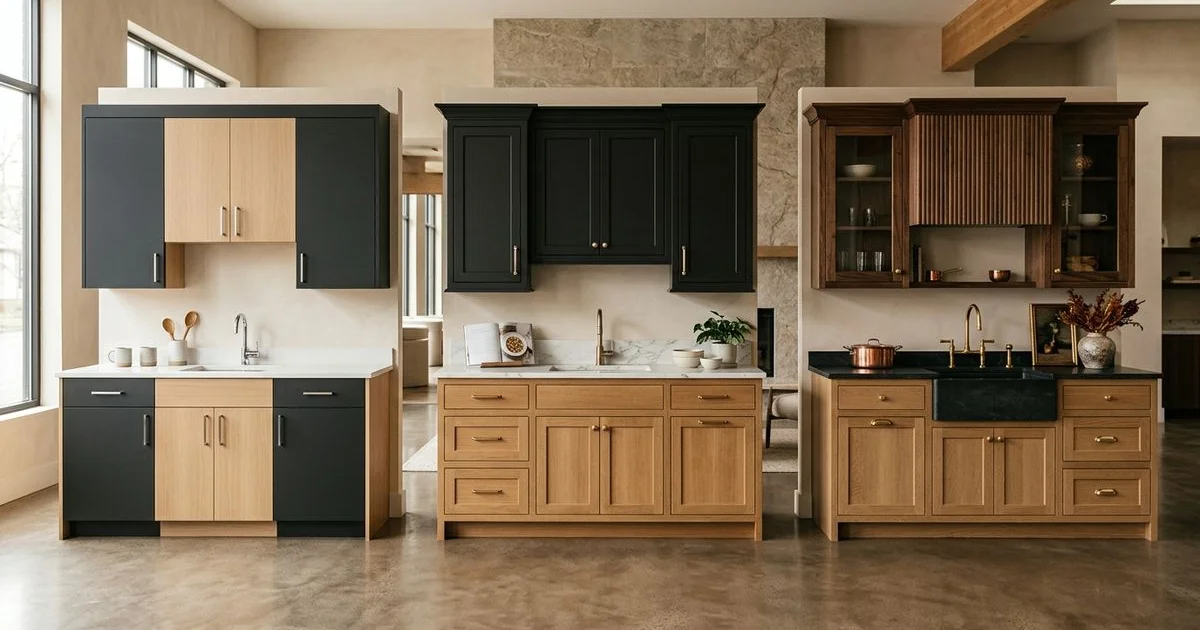
What Are the Three Tiers?
Stock cabinets are manufactured in fixed sizes and held in inventory. You pick from a size range and fill the leftover space with filler strips. Fast, inexpensive, and constrained.
Semi-custom cabinets are factory-built to order within a defined set of options: incremental widths, a door style menu, a finish menu, and some interior fittings. More flexible, longer lead time, higher cost.
Custom cabinets are made for your room specifically. Dimensions, species, door style, finish, and interior configuration are all open. That is what we build through our Custom Kitchen Cabinets service.
How Do They Compare?
| Stock | Semi-custom | Custom | |
|---|---|---|---|
| Sizing | Fixed increments | Limited increments | Made to measure |
| Box material | Often particleboard | Plywood option | 3/4-inch plywood standard |
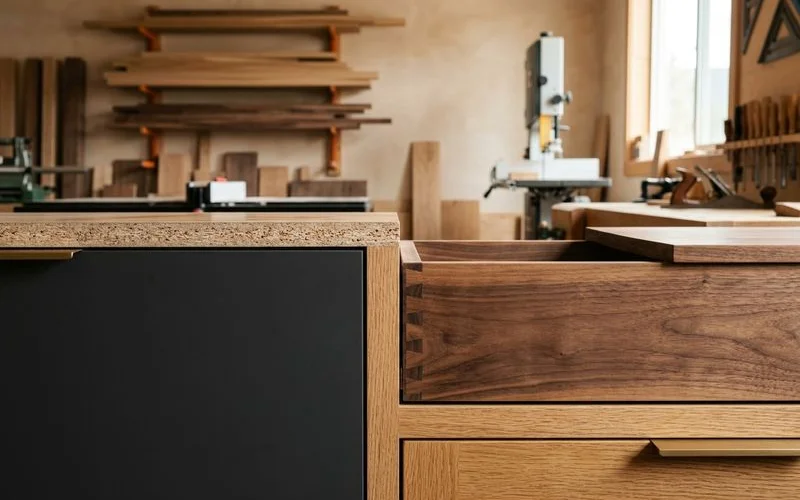
| Drawer boxes | Stapled or metal-sided | Varies | Solid wood, dovetailed |
| Door styles | Small menu | Larger menu | Unlimited, including true inset |
| Finish | Factory, standard range | Factory, wider range | Shop-applied conversion varnish |
| Lead time | Days to weeks | Several weeks | Several weeks to months |
| Relative cost | Lowest | Middle | Highest |
Where the Difference Actually Shows
Fit. This is the honest headline. Stock and semi-custom both use filler strips to close the gap between a nominal size and your real wall. In a newer house with square walls, fillers are barely noticeable. In a 1915 Portland Foursquare with walls that wander, they are the first thing you see, and they get wider along the run.
Material. Box construction varies enormously across tiers. Particleboard boxes fail once moisture reaches an unsealed edge, and in a Pacific Northwest kitchen that is a question of when. Quality plywood boxes do not.
Joinery. Dovetailed solid-wood drawers resist the racking force of a loaded drawer being pulled at an angle. Stapled boxes loosen over years of that.
Door style. True beaded inset requires a face frame built to tight tolerances and doors individually fitted to their openings. It is genuinely unavailable at the stock tier and rare at semi-custom.
Interior fit-out. Pull-out pantries, appliance garages, drawer dividers cut to your utensils, integrated lighting. Available in menus lower down, made to your actual requirements at the top.
The question that settles the tier
Is your room standard, and is your house one where cabinetry will be judged? A square room in a modest house is well served by semi-custom. An awkward or historic room in a high-value house is where custom stops being a luxury and starts being the sensible answer.
When Each Tier Is Right
Choose stock for rentals, secondary kitchens, utility rooms, or a fast refresh before a sale where budget governs everything.
Choose semi-custom for a standard-sized kitchen in a newer home where the layout works and you want a better finish than stock without bespoke cost.
Choose custom when the space is awkward, the home is historic or high-value, you want inset doors or grain-matched runs, or you intend to keep the kitchen for decades. Also choose it when storage is the real problem, because reclaiming wasted volume is something only made-to-measure work can do properly.
An Honest Note
We build at the top tier, so treat our view accordingly. That said, we have told clients to buy semi-custom more than once, because their room was square, their budget was firm, and bespoke work would not have earned its premium there. If you want that argument made in full, we weigh it up in are custom kitchen cabinets worth the cost.
Where it does earn it, the difference is not subtle, and it lasts a very long time.