How Should You Match Species to Find the Best Wood for Kitchen Cabinets in Portland?
Designing a luxury kitchen in the Pacific Northwest requires looking far beyond mere aesthetics to find the best wood for kitchen cabinets. Our team frequently sees high-end remodels suffer because the materials simply cannot handle the local climate. Choosing the right kitchen cabinet wood species prevents warped doors, cracked paint, and costly callbacks down the road.
We rely on three specific inputs to settle the material debate for almost every project passing through our Custom Kitchen Cabinets service. Start with the finish, then evaluate the architecture, and finally calculate the expected wear.
A long, damp winter with morning humidity hitting 85 percent is routinely followed by dry, 38 percent humidity summer afternoons. You will see these drastic seasonal moisture swings show up quickly in the reveals of dimensionally unstable lumber.
Let’s look at the data, what it actually tells us about different options, and explore the exact specifications that work best in this region.
Painted Kitchens: Solid Maple
If your design calls for painted cabinetry, solid hard maple is the definitive answer. Our standard specification for beaded inset doors in a historic Portland estate is almost always painted maple. The reasoning comes down to cellular structure and sheer density.
Maple features a closed, tight grain pattern. This microscopic density ensures the painted finish reads as a perfectly uninterrupted, smooth surface. Oak, by comparison, has an open pore structure that telegraphs a faint, distracting texture through the paint.
Hard maple boasts a Janka hardness rating of 1,450 pound-force (lbf). We find this density crucial for base runs and drawer fronts that endure heavy daily use. It takes the wear beautifully and holds exceptionally crisp edges on complex profiled doors.
Key advantages of solid maple for painted applications include:
- Superior Dent Resistance: A 1,450 lbf Janka rating handles heavy pot and pan impacts.
- Zero Grain Telegraphing: The closed pores guarantee a glass-smooth painted finish.
- Crisp Profiling: The dense wood fibers allow for sharp, detailed router work on inset doors.
- Climate Stability: It resists swelling during those damp Oregon winters.
Stained Kitchens: Rift-Cut White Oak
White oak is highly durable and takes stain evenly across its surface. Our favorite application for contemporary commercial spaces or luxury kitchens is stained oak. Blotchy stain uptake is the fastest way to make a custom kitchen look cheap.
The milling cut is the most critical decision you will make here. Plain-sawn oak shows broad cathedral arches that can look busy and dated. Rift-cut oak is sawn at roughly a 60-degree angle to the growth rings.
This specific milling angle produces a straight, uniform grain with essentially no arching. We carefully select and sequence these rift-sawn boards so the linear grain flows continuously across a long run of drawer fronts. It reads as calm, intentional, and highly modern.
White oak is naturally equipped to handle Portland’s humidity. It possesses a Janka hardness rating of 1,360 lbf and features a closed cellular structure filled with tyloses. These natural blockages make the wood highly resistant to moisture and rot.
The Cost of Consistency: Rift sawing yields about 55 to 60 percent product loss per log compared to traditional plain sawing. This lower yield increases the price by several dollars per board foot, but it is one of the few upgrades that clients can instantly recognize from across the room.
Islands and Feature Pieces: Black Walnut
Premium black walnut requires absolutely no stain. Its natural color spectrum ranges from deep chocolate brown to subtle purple-grey tones. Sweeping, dramatic grain figures are the entire point of this species, and staining it is practically vandalism.
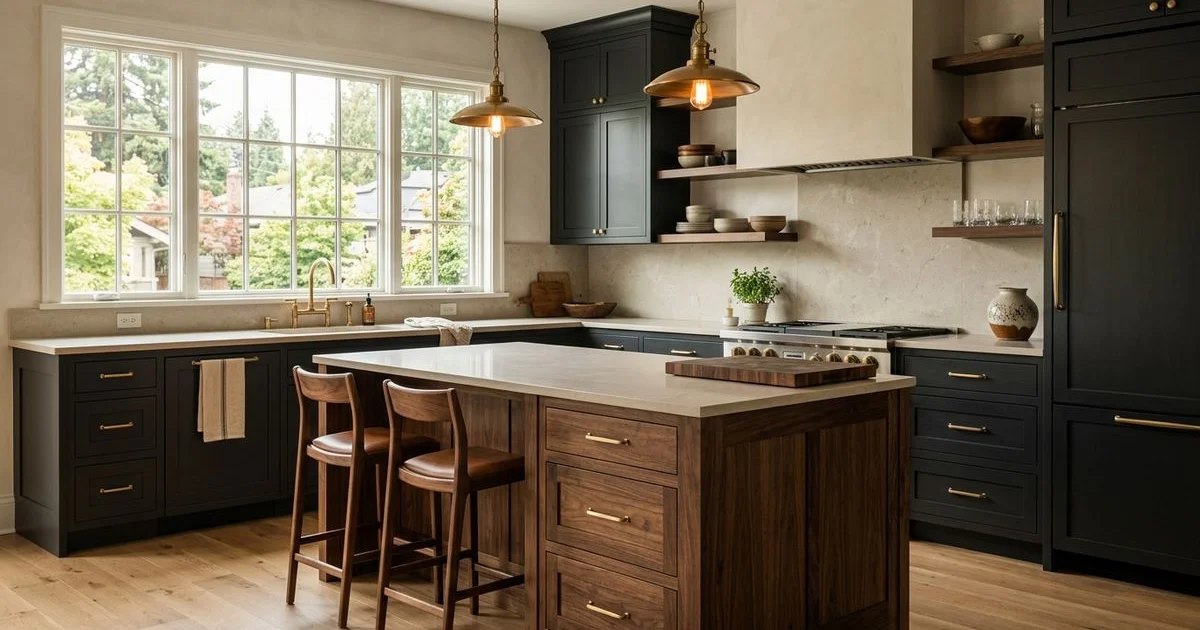
We prefer to use walnut where a single architectural element needs to anchor the entire room. Placed against a painted maple perimeter or a light rift-oak run, a walnut island reads as a high-end furniture piece rather than basic cabinetry. It provides striking contrast and structural hierarchy.
You must consider the hardness difference when placing this material. Black walnut carries a Janka rating of 1,010 lbf, making it about thirty percent softer than hard maple. Our installation crews always recommend placing it on islands and feature pieces rather than hard-working prep perimeters because it marks more readily.
There is one critical Portland-specific note regarding natural light. Walnut actually lightens and turns slightly yellow with prolonged UV exposure over the years. In a kitchen featuring strong south or west-facing windows, you must protect the wood.
The combination most clients land on
Painted maple perimeter, rift-cut white oak tall cabinetry, black walnut island. Warmth, hierarchy, and enough contrast to give the room structure without turning it into a timber sample board.
To protect your walnut investment from sun bleaching, insist on these finishing protocols:
- Apply a dark walnut Danish oil base to lock in the deep, rich pigments.
- Specify a premium UV-resistant topcoat, such as a high-performance water-based polyurethane.
- Re-evaluate window treatments in rooms with direct, sustained afternoon sunlight.
Species at a Glance
| Species | Finish | Hardness Rating | Best Use | PNW Climate Note |
|---|---|---|---|---|
| Solid hard maple | Paint | 1,450 lbf (High) | Perimeter, base runs, inset doors | Highly stable against moisture |
| Rift-cut white oak | Stain | 1,360 lbf (High) | Contemporary runs, tall cabinetry | Rot-resistant, grain-matchable |
| Black walnut | Clear | 1,010 lbf (Medium) | Islands, vanities, furniture pieces | Lightens in strong UV exposure |
What About Other Species?
Many clients ask about alternative domestic hardwoods for their projects. American cherry, for instance, darkens significantly during its first six months of light exposure. Some homeowners love this deep oxidation process, while others find the rapid color shift surprising.
High-Durability Options
Hickory and ash offer incredible options if you need a highly durable kitchen wood for commercial spaces. We regularly see hickory clock in at a massive 1,820 lbf on the Janka scale, making it nearly dent-proof. The clear tradeoff is a visually chaotic grain pattern that can easily overwhelm a sophisticated design.
Before committing to an alternative wood species, consider these three critical factors:
- Oxidation Rates: Will the color shift drastically over the first year like cherry?
- Impact Resistance: Does the Janka rating support the room’s daily traffic?
- Grain Prominence: Will the natural pattern clash with your countertops and flooring?
Softer Woods and Final Considerations
Clear alder presents the opposite problem due to its extremely low density. It carries a Janka rating of just 590 lbf, making it exceptionally prone to denting from minor impacts. Our team strictly reserves alder for low-traffic decorative elements or rustic applications where distress marks add character.
Any reputable custom shop can source and build with these alternative materials. We find that our three signature species simply cover the vast majority of what the luxury market demands.
Species is only one half of the specification, though. The box behind the door, the joinery, and the drawer construction matter just as much to how a kitchen ages, and we cover those choices in what goes into a custom kitchen cabinet build.
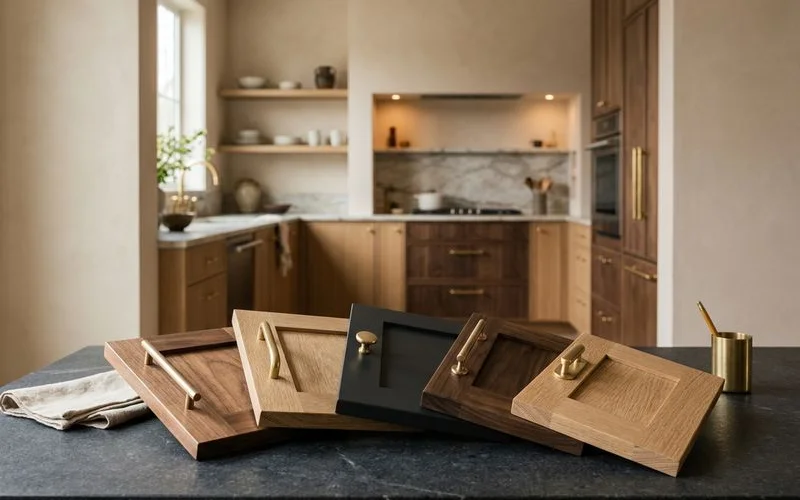
Whatever material you lean toward, you must judge it as a finished sample in your own home to ensure you select the best wood for kitchen cabinets. Stain behaves completely differently under a cloudy, north-facing Portland window than it does under artificial showroom lighting.
Schedule a consultation with our design specialists today.
We will review finish samples in your actual space and help you plan a kitchen that truly thrives in the Pacific Northwest.