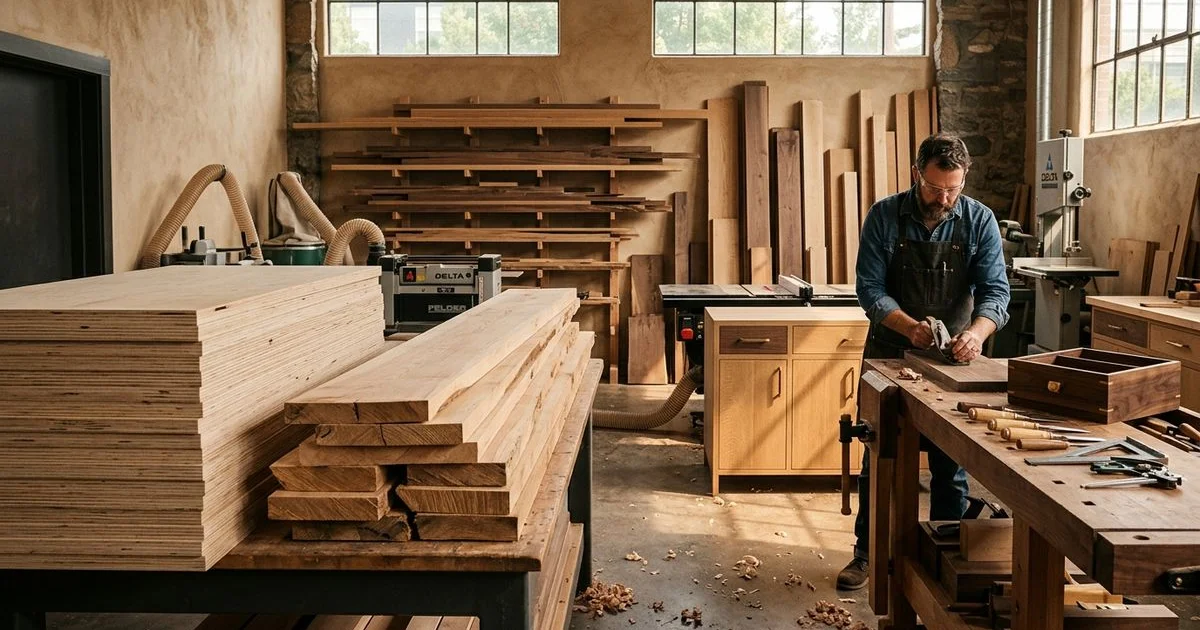
What Are Cabinet Boxes Actually Made Of?
The box, or carcase, is the structural shell every cabinet is built around. It carries the shelf load, holds the hinges, and keeps the whole assembly square. It is also the part you never see and almost never ask about, which is exactly why it is where corners get cut.
There are three common answers. Particleboard and MDF sit at the bottom of the market: cheap, heavy, and quick to fail once moisture reaches an unsealed edge. Quality plywood sits in the middle and at the top of the custom trade. Solid hardwood boxes are rare, expensive, and, counter-intuitively, not the best choice for most cabinetry.
Every kitchen we build in our Custom Kitchen Cabinets service uses 3/4-inch Baltic birch plywood boxes. Here is the reasoning, which comes down to how wood behaves in a Portland winter.
Why Does Plywood Win on Stability?
Wood moves. It absorbs moisture from humid air and releases it in dry air, expanding and contracting across the grain as it does. A wide solid panel can move a noticeable amount across its width between a wet January and a dry August, and it moves far less along its length.
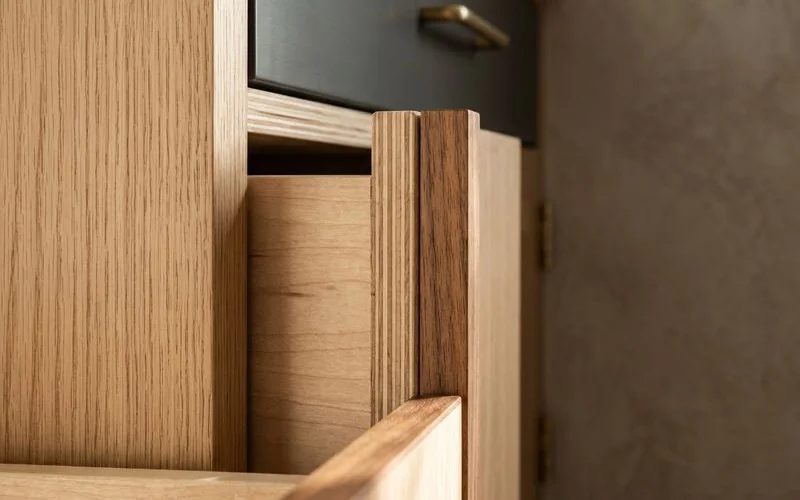
Plywood solves this by alternating the grain direction of each layer. Each ply restrains the one next to it, so the panel stays close to its original dimensions in both directions. In a climate like the Pacific Northwest, where indoor humidity swings substantially across the year, that restraint is the difference between reveals that stay even and doors that start to catch by year three.
Baltic birch takes it further. It has more plies than standard cabinet-grade plywood, uses thin uniform layers, and is void-free, meaning no internal gaps that weaken a screw fixing or a shelf-pin hole. It also machines to a clean edge, which matters when a case interior is visible.
Where solid wood does belong
Doors, face frames, drawer sides, and mouldings. These are narrow or framed components where wood movement is either restrained by construction or accommodated by design. A solid-wood raised panel floats within its frame precisely so it can move without splitting.
How Do the Options Compare?
| Material | Stability in PNW humidity | Strength & screw holding | Typical use |
|---|---|---|---|
| Particleboard / MDF | Poor once an edge is exposed | Weak, strips easily | Budget flat-pack |
| Cabinet-grade plywood | Good | Good | Mid-market custom |
| Baltic birch plywood | Excellent | Excellent, void-free | Premium bespoke |
| Solid hardwood panel | Moves seasonally across width | Excellent | Doors, frames, drawers |
Cost tracks that table closely. Baltic birch runs meaningfully more per sheet than standard cabinet ply, and solid hardwood boxes more again. But box material is a small fraction of total project cost compared with doors, finishing, and hardware, which makes it one of the least sensible places to economise. Upgrading the box adds a modest amount to a kitchen and adds years to its working life.
What Should You Ask a Cabinet Maker?
Three questions separate serious shops from the rest. What thickness and grade is the box material? Is it void-free? And are the interior surfaces sealed, or only the visible faces?
The last one catches people out. An unsealed interior is a moisture path, and in a Portland kitchen or bathroom that path eventually reaches a joint. We seal all faces, including undersides and backs, with the same system described in our guide to conversion varnish finishes and Pacific Northwest moisture.
If you want to see the difference in person rather than read about it, request a consultation and we will bring sample boxes to the meeting. A cut-through panel explains this faster than any specification sheet.