Why Does Cabinet Hardware Matter So Much?
Hardware is the part of a kitchen you physically touch, thousands of times a year. It is also the component most likely to fail first, and the one people most often economise on without realising what they are trading away.
On every kitchen we build through our Custom Kitchen Cabinets service, Blum concealed soft-close hinges and undermount glides are the baseline rather than an upgrade. Here is what that specification actually buys.
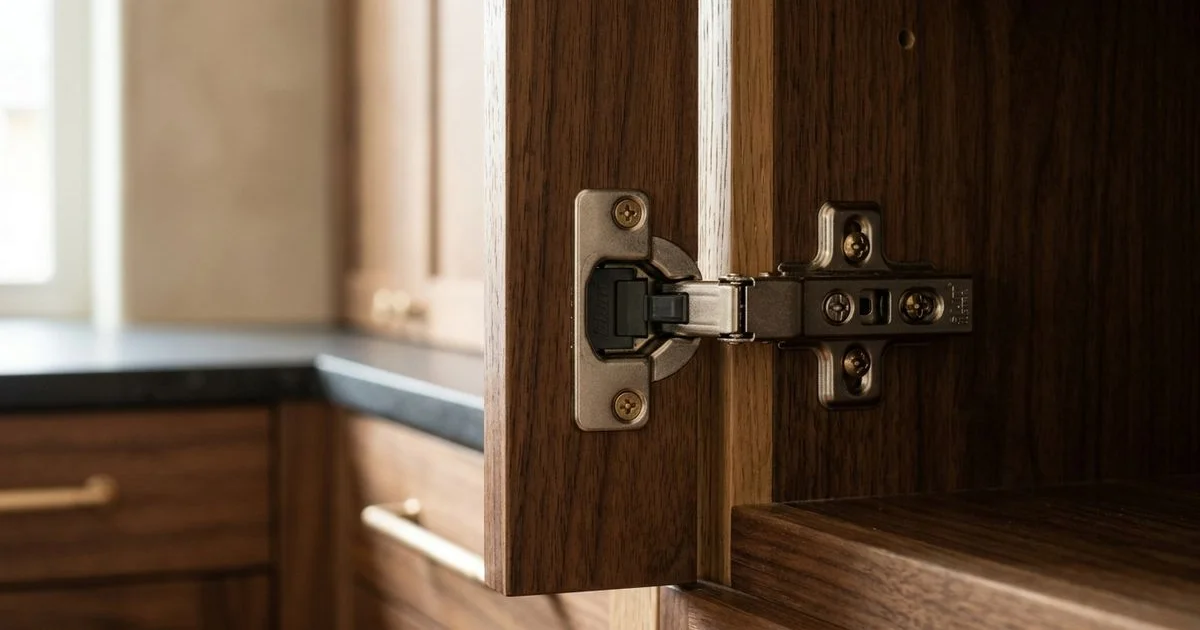
Concealed Soft-Close Hinges
A concealed hinge sits inside the cabinet, invisible when the door is shut. Soft-close adds a hydraulic damper that catches the door in the final stretch of travel and eases it home.
The comfort is obvious. The durability benefit is less obvious and more valuable: every slammed door transmits impact through the hinge, the frame, and the finish. Removing that impact from a decade of daily use is why soft-close cabinetry still closes crisply years later.
The other advantage is adjustability. Quality concealed hinges adjust in three planes: side to side, in and out, and up and down. In a century-old Portland home where the structure moves seasonally, that adjustability is what lets us bring reveals back to true during a service visit rather than rebuilding anything.
Blum’s Expando T system is worth a specific mention. It is a fixing method that grips the door material more securely, which matters on heavy doors and on thinner panels where a conventional screw fixing eventually loosens.
Drawer Glides
Undermount soft-close glides sit beneath the drawer box rather than at its sides. That gives you the full width of the drawer, hides the mechanism completely, and lets a solid-wood dovetailed box show as the furniture piece it is.
Two specifications matter. Full extension means the whole drawer comes clear of the cabinet, so the back of a deep pan drawer is actually reachable. Load rating governs how the drawer behaves when it is full; a drawer of cast-iron pans on an underrated glide will sag and eventually bind.
Where cheap hardware shows itself
Not in year one. In year six, when doors have dropped, drawers rock as they close, and someone has to be called out to adjust a kitchen that should never have needed adjusting.
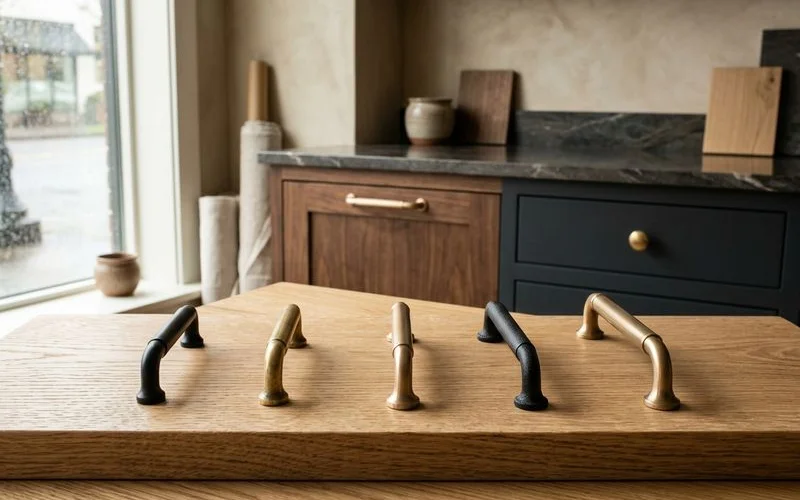
Visible Hardware: Pulls and Knobs
This is the jewellery, and it is the cheapest way to change the character of a kitchen.
Unlacquered brass is living hardware. It starts bright and develops a patina where hands touch it, unevenly and beautifully. It suits historic homes and clients who want the kitchen to age visibly.
Champagne bronze is our most requested finish. Warm, slightly muted, and stable, meaning it holds its tone rather than shifting as it wears. Against rift-cut white oak or walnut it does something polished chrome never manages.
Matte black is consistent, contemporary, and forgiving of fingerprints. It suits slab and full-overlay doors particularly well.
| Finish | Character | Ages? | Suits |
|---|---|---|---|
| Unlacquered brass | Bright, then patinated | Yes, deliberately | Historic, Craftsman |
| Champagne bronze | Warm, muted | Minimal | Transitional, luxury |
| Matte black | Flat, graphic | No | Contemporary, minimalist |
Interior Fittings Worth Considering
Pull-out pantry units, appliance garages with tambour or bi-fold doors, cutlery and utensil dividers cut to your drawer sizes, tray dividers beside the oven, and integrated LED lighting in shelf fronts and toe kicks. None are essential; all are far cheaper to build in now than to retrofit later.
We walk through these during the 3D design stage, when adding one costs a conversation rather than a rebuild. Hardware sits inside a much larger specification, and what goes into a custom kitchen cabinet build walks through the boxes, doors, and joinery it all mounts to.